
Deck Repair or Rebuild? The 3-Point Test for Homeowners
Is your deck showing its age? Before you call a pro, use our 3-point test (Structure, Surface, Style) to decide if you need a simple repair, a major resurfacing, or a full rebuild.
Your deck is the heart of your backyard. It’s where you host summer barbecues, watch the kids play, and unwind after a long day. But all that exposure to sun, rain, and snow takes its toll. Eventually, every deck owner faces the same big question: is it time to repair the deck I have, or do I need to tear it down and rebuild from scratch?
Making the right call isn't just about the upfront cost. It’s about the safety of your family, the long-term value of your home, and how much maintenance you’re willing to do for the next decade. Throwing money at constant repairs for a failing structure is a losing game, but a full rebuild might be overkill if the bones of your deck are still strong.
To help you make an informed decision before you even call a contractor, we’ve created a simple 3-Point Test. By looking at your deck’s Structure, its Surface, and its Style, you can get a clear idea of what your project really needs. This guide will walk you through what to look for, so you can have a smarter conversation with the pros you hire.
The Big Question: Why Not Just Repair Everything?
In a perfect world, we could just replace a board here and tighten a railing there, and our decks would last forever. While spot repairs are great for minor issues, there's a tipping point where continuing to patch up an old deck becomes a bad investment. Think of it like an old car—at some point, you're spending more on repairs than the car is worth.
One of the biggest factors homeowners often overlook is building code. Safety standards for decks have changed significantly over the years. A deck built 20 years ago might not meet today's requirements for railing height, baluster spacing, or—most critically—how it’s attached to your house. A simple repair job doesn't legally require you to upgrade the entire structure to meet new codes. However, if a pro is doing a major overhaul or a full rebuild, the new work must be built to current code. This is a good thing; it ensures your new deck is as a safe as possible.
Financially, the law of diminishing returns is a huge factor. If the cost to repair your existing deck—for example, replacing all the decking, railings, and stairs—approaches 50-60% of the cost of a brand-new deck, most professionals will advise you to rebuild. A full rebuild gives you a completely new, safe structure with a full lifespan ahead of it, often with better materials and a warranty. Sinking thousands into repairing a 20-year-old frame that might only last another 5-7 years is often not the wisest use of your home improvement budget.
The 3-Point Test: How to Assess Your Deck
This test is designed for you, the homeowner, to perform a basic visual inspection. You don't need to be a deck builder to spot the most common red flags. Finding these issues ahead of time will help you understand the scope of your project and communicate more effectively with contractors. Grab a flashlight and a screwdriver with a flat head—it's your best tool for probing for rot.
Here are the three areas we'll examine:
- The Structure (The Bones): This is the underlying framework holding everything up. Structural issues are the most serious and often point toward a full rebuild.
- The Surface (The Skin): This includes the decking you walk on and the railings you touch. Surface problems are common and are often good candidates for repair or resurfacing.
- The Style & Function: This is about how the deck works for your family and lifestyle. This isn't about safety, but it's a critical factor in deciding if you should invest in a brand new, custom space.
Point 1: The Structural Inspection (The Bones)
Safety first. The structural integrity of your deck is non-negotiable. Problems here can lead to catastrophic failure, so take this part of the inspection seriously. Pay close attention to any wood that is in direct contact with the ground or the house.
Posts and Footings
The posts are the vertical legs of your deck, and they rest on concrete footings in or on the ground. They carry the entire weight of the deck and everyone on it.
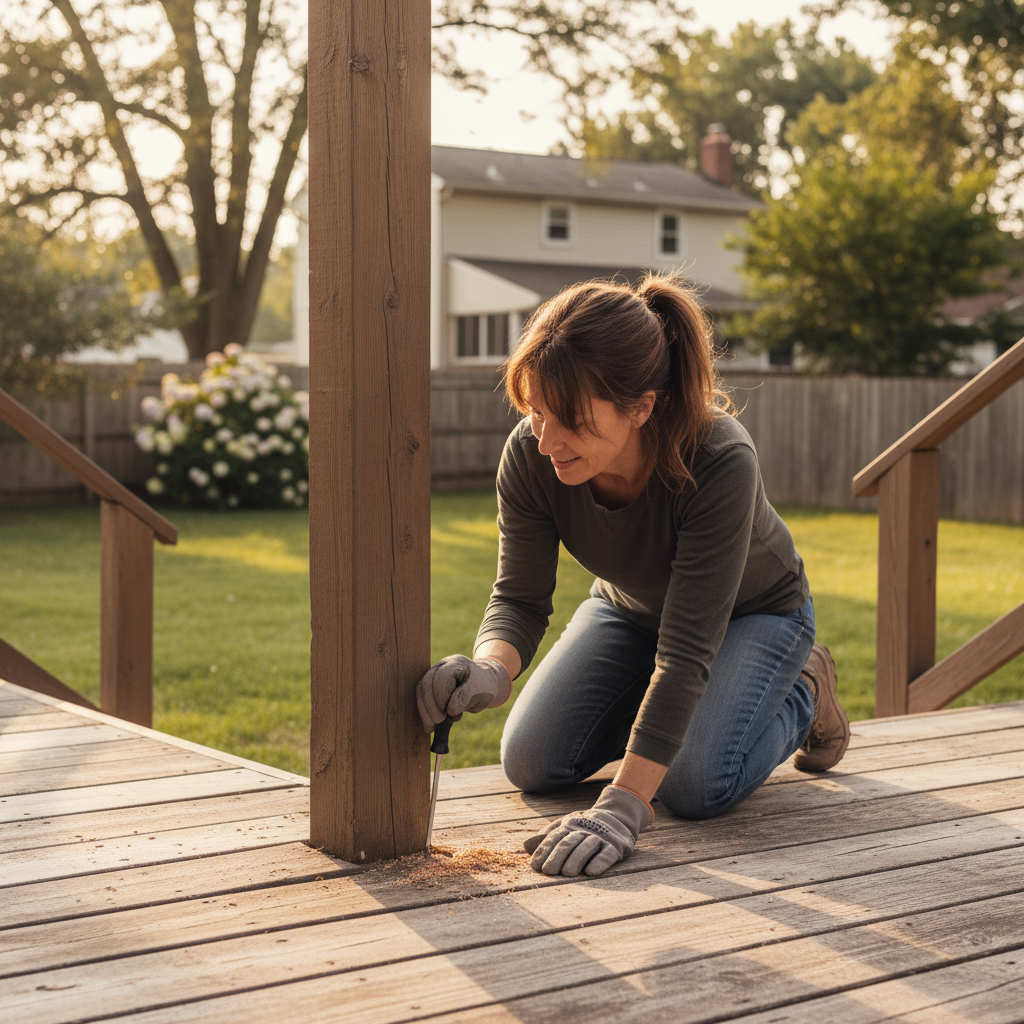
- How to Check: Look at the bottom of each wooden post where it meets the ground or the footing. Is the wood soft, discolored, or crumbling? Gently—but firmly—poke the base of the post with your screwdriver. If it sinks in easily, you have rot. Also, look at the deck from a distance. Does it appear to be sinking in one corner? This could indicate a failed footing.
- The Verdict: Rotted posts are a dealbreaker. They cannot be effectively repaired and must be replaced. If multiple posts are rotten or the footings have sunk or cracked, the foundation of your deck is compromised. This almost always means a full rebuild is the only safe option.
Ledger Board and Flashing
The ledger board is the piece of lumber that attaches the deck directly to your house. It is the single most common point of deck failure, and it's absolutely critical that it's secure.
- How to Check: Look under the deck where it meets the house. The ledger should be attached with large bolts or structural screws (often called lag screws), not just nails. See any signs of rust or corrosion on the fasteners? More importantly, look for a piece of metal or vinyl L-shaped trim tucked under your home's siding and draped over the top of the ledger board. This is called 'flashing,' and its job is to keep water from getting behind the ledger and rotting out both the deck and the wooden structure of your house. If there's no flashing, or you see water stains or rot on your house's sheathing, you have a serious problem.
- The Verdict: A missing, improperly installed, or corroded ledger board is a ticking time bomb. The rot it causes can lead to thousands of dollars in home repairs on top of the deck replacement. A compromised ledger board is an immediate safety hazard that requires a rebuild, not a repair.
Joists and Beams
Beams are the main horizontal supports that rest on the posts, and joists are the smaller boards that run perpendicular to the beams, forming the grid that your deck boards are screwed into.
- How to Check: From under the deck, visually inspect all the joists and beams for long cracks, sagging, or signs of rot (especially at the ends where they connect to other boards). Use your screwdriver again to probe any suspicious-looking spots. Does the deck feel unusually bouncy or spongy when you walk across it? This could mean the joists are undersized or spaced too far apart for the type of decking used.
- The Verdict: If you find rot in one or two joists, a contractor can often 'sister' a new joist alongside the old one as a repair. However, if the rot is widespread, if the main support beams are compromised, or if the entire frame is bouncy and undersized, you’re looking at a rebuild.
Point 2: The Surface Assessment (The Skin)
This part of the inspection deals with the elements you see and interact with every day. Issues here are more about aesthetics and day-to-day safety (like splinters and wobbly railings) and are more likely to be fixable without a full teardown.
Decking Boards
These are the boards you walk on. They take the most direct abuse from foot traffic and weather.
- How to Check: Walk the entire surface. Are boards warped, cupped, or severely splintered? Do you see popped nails or screws? Pay special attention to boards in shady, damp areas or around planters, as these are the first to rot. If you have a composite deck, check for deep scratches, fading, or staining.
- The Verdict: Replacing a handful of damaged boards is a straightforward and affordable repair. If more than a quarter of your decking is in bad shape, it's time to consider a full 'resurfacing' (also called 're-decking'). This involves removing all the old decking and railings and installing new ones on your existing frame—but only if your structural inspection (Point 1) came back clean.
Railings and Stairs
Railings prevent falls, and stairs need to be solid. Their stability is crucial.
- How to Check: Perform the 'wobble test.' Grab the top of the railing and give it a firm shake. It shouldn't move more than an inch or so. If it feels loose and rickety, inspect how the railing posts are attached to the deck frame. Are the bolts rusted or loose? Is the wood around the bolts soft? For stairs, inspect the 'stringers'—the sawtooth-shaped boards that support the steps. Probe them for rot, especially where they meet the ground.
- The Verdict: Wobbly railings are a serious safety hazard but can sometimes be repaired by replacing hardware and adding blocking for reinforcement. If the main rail posts themselves are rotted through, they must be replaced. Damaged stair treads are an easy fix, but rotted stringers are a major repair that often requires rebuilding the entire staircase. Keep in mind that modern codes have strict rules for railing height (usually 36 inches) and spindle spacing (less than a 4-inch gap), so any major rail repair is a good opportunity to upgrade for safety.
Here are some clear signs your deck surface needs attention:
- Widespread, deep splinters that make it unsafe to walk barefoot.
- Boards that feel spongy or soft underfoot.
- Dozens of protruding nail or screw heads that can't be fixed by simply hammering or screwing them back in.
- Railings that move significantly when you push on them.
- Visible rot on stair stringers where they meet the ground or deck.
Point 3: Style, Function, and Future Plans
This final point moves beyond safety and into how your deck fits your life. A structurally sound deck might still be the wrong deck for you. A rebuild is your chance to get exactly what you want.
The Material Question
Is your old, pressure-treated pine deck a maintenance nightmare of sanding and staining every other year? A rebuild is the perfect time to upgrade to low-maintenance materials. Composite decking (like Trex, TimberTech, or Fiberon) costs more upfront but requires only occasional cleaning and comes in a huge variety of colors. Or you could opt for a beautiful, long-lasting hardwood like Ipe or Tigerwood. Repairing or resurfacing locks you into keeping that old frame, which was designed for wood. A rebuild lets you start fresh with a material that better suits your budget and tolerance for maintenance.
The Layout and Size
Your family's needs change over time. The small deck that was fine for you as a couple might feel cramped now that you have kids and a dog. Do you wish you had a built-in bench, a designated space for the grill, or a pergola for shade on hot afternoons? Do the stairs land in an awkward spot in the yard? You can't fix these functional issues with a simple repair. A rebuild is your opportunity to completely re-imagine your outdoor living space, improve traffic flow, and create a deck that truly works for how you live today.
Long-Term vs. Short-Term Thinking
Finally, consider your timeline. Are you planning to sell your house in the next two to three years? If so, a cost-effective repair that makes the deck safe and presentable might be the smartest financial move. A buyer will appreciate a sound deck, but you may not fully recoup the cost of a high-end composite rebuild in a quick sale.
On the other hand, if this is your 'forever home,' investing in a full rebuild with high-quality, low-maintenance materials can provide 25+ years of worry-free enjoyment. It's an investment in your family's quality of life, not just a line item on a home inspection report.
The Verdict: Making the Call
Now, let's put it all together. Using your findings from the 3-Point Test, you can confidently decide which path is right for you.
You should probably REPAIR your deck if:
- Your structural inspection (Point 1) shows the posts, ledger board, and joists are all dry, solid, and rot-free.
- Fewer than 20-25% of your surface boards are damaged.
- Your railings are a bit wobbly but the support posts are solid and just need to be re-secured.
- The deck's size and layout still work for you.
- Your primary goal is to safely extend the life of your current deck for a few more years on a tight budget.
You should seriously consider a REBUILD (or at least a full RESURFACE) if:
- You found any rot or instability in the ledger board, posts, or support beams.
- The deck frame is bouncy, undersized, or has widespread joist rot.
- More than a third of the decking and railings need to be replaced. At this point, the labor cost begins to approach that of a rebuild.
- You want to switch from wood to low-maintenance composite decking.
- You want to change the size, shape, or location of your deck.
When you call a deck builder, being able to say, "The frame seems solid, but I'm looking to resurface with composite," or, "I'm concerned about the ledger board and think I need a full replacement," will lead to a much more productive conversation. It shows you're an informed homeowner and helps the pro understand your needs and concerns right from the start.
Budgeting for Your Deck Project
Deck costs can vary dramatically based on your location, the materials you choose, and the complexity of the design. These are typical, all-in price ranges you can use for initial planning in the US market. Always get multiple quotes from vetted local contractors.
Small Repairs:
- Replacing a few boards or a single stair tread: $300 – $700
- Securing and reinforcing railings: $500 – $1,500
- Replacing a small, simple set of stairs: $1,500 – $3,500
Resurfacing (New decking & railings on old frame):
- Pressure-Treated Pine: $25 – $40 per sq. ft.
- Mid-Range Composite: $45 – $70 per sq. ft.
Full Rebuild (New frame, footings, decking & railings):
- Pressure-Treated Pine: $40 – $65 per sq. ft.
- Mid-Range Composite: $70 – $110+ per sq. ft.
Don't forget permits. Most full rebuilds, resurfacing projects, and major structural repairs will require a building permit from your city or county. This ensures the work is inspected for safety and code compliance. A permit can add several hundred to over a thousand dollars to the project cost and a few weeks to the timeline. Minor repairs typically do not require a permit, but it's always wise to check with your local building department.
Frequently asked questions
How long should a wood deck last?+
A well-maintained pressure-treated pine deck typically lasts 15-25 years. More premium woods like cedar or redwood can last 25-40 years. However, lifespan depends heavily on the local climate, sun exposure, and how consistently it is cleaned and sealed.
Can I just replace my wood deck boards with composite?+
Yes, this is called resurfacing and it's a popular option. However, it's only possible if your deck's structural frame is in excellent condition and the joist spacing meets the requirements for the new composite decking, which is typically 16 inches on-center or less. A professional must verify the frame's integrity before you proceed.
Do I need a permit to repair my deck?+
For minor, non-structural repairs like replacing a few boards, you typically don't need a permit. For any structural work, a full rebuild, expanding the deck, or even replacing all the railings or stairs, a permit is almost always required. Always check with your local building department before starting work.
What's the best time of year to do deck work?+
Spring and fall offer the most pleasant weather for construction, but contractors are also at their busiest, so book well in advance. You might find better pricing or availability in the late fall or even winter, as long as your climate allows for concrete footings to be poured and materials to be installed properly.
Is a wobbly railing a big deal?+
Yes, it is a very big deal and a serious safety hazard. Wobbly railings are a leading cause of deck-related injuries and a red flag for home inspectors. It indicates a failure in the post connections or rot in the frame, which needs to be addressed immediately to prevent a dangerous fall.