
Tankless vs. Tank Water Heaters: Which Is Right for Your Home?
Deciding between a traditional tank and a tankless water heater? We break down the huge differences in cost, performance, and lifespan to help you make the right choice when hiring a plumber.
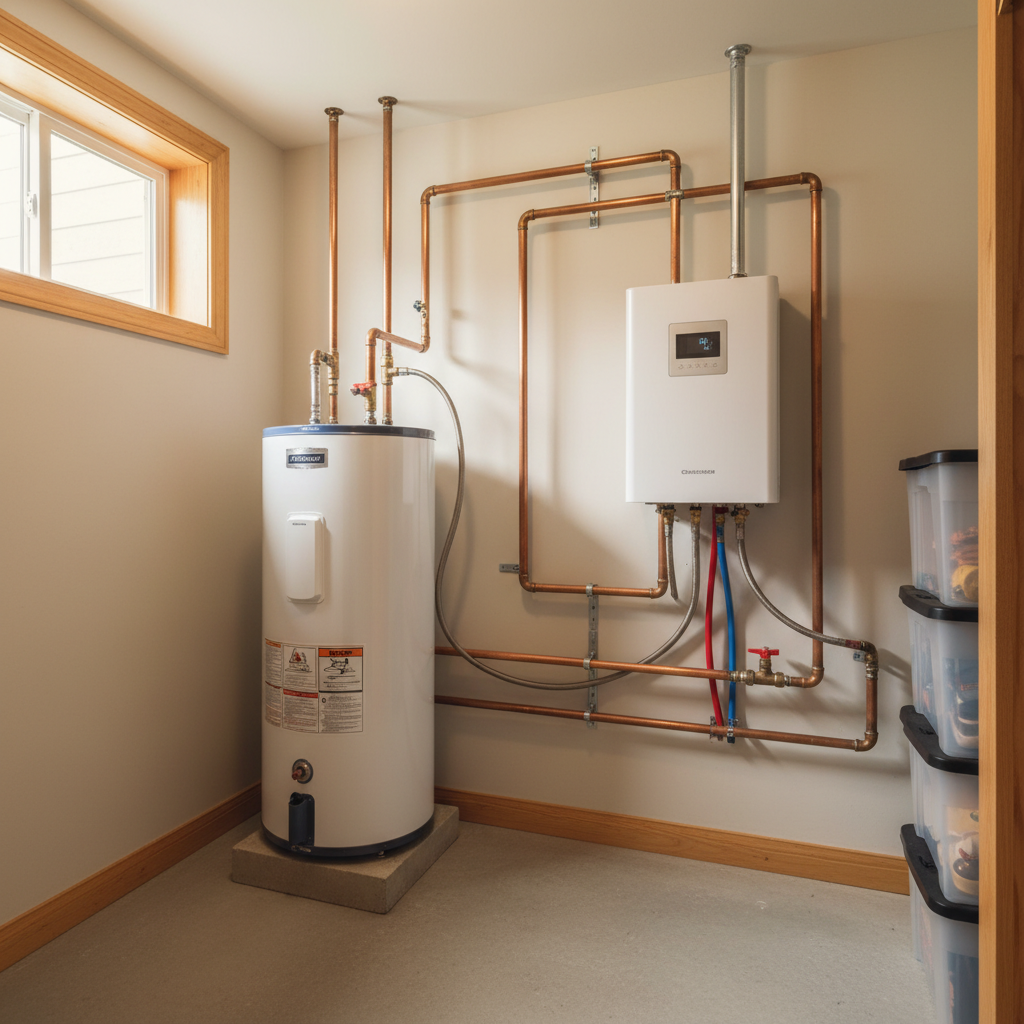
Your water heater is one of the hardest-working appliances in your home. You rely on it for hot showers, clean dishes, and fresh laundry. But most of the time, you probably don't think about it—until the day it stops working. When that cold shower hits, you're suddenly faced with an urgent decision and a call to a plumber.
The two main choices on the market today are the traditional storage-tank water heater and the modern tankless (or on-demand) water heater. They do the same job but in fundamentally different ways, with major implications for your budget, your home's infrastructure, and your daily routine.
This guide will walk you through the real-world differences between tank and tankless water heaters. We'll cut through the marketing hype and focus on what matters to a homeowner: upfront costs, long-term savings, performance, lifespan, and what to ask a plumbing pro before you commit to one over the other.
How Each Water Heater Type Works
Before we talk cost and performance, it helps to understand the basic technology. A plumber can give you the technical rundown, but here's the simple version.
Traditional Storage-Tank Water Heaters: The Familiar Workhorse
This is the type of water heater most Americans grew up with. It's essentially a large, insulated steel tank that holds and heats a reservoir of water—typically 40 to 80 gallons—and keeps it hot 24/7.
Think of it like a giant thermos connected to your plumbing. A gas burner at the bottom or electric heating elements inside the tank periodically fire up to maintain the water temperature at a set level (usually 120-140°F). When you turn on a hot water tap, hot water is drawn from the top of the tank and cold water enters the bottom to be heated. It's a simple, time-tested design.
Tankless (On-Demand) Water Heaters: Hot Water When You Need It
A tankless water heater has no tank and stores no hot water. Instead, it heats water instantaneously as you need it. When you turn on a hot water tap, water flows through the compact, wall-mounted unit. A sensor detects the flow and ignites a powerful gas burner or a series of electric elements, heating the water as it passes through a heat exchanger. When you turn the tap off, the unit shuts down.
Think of it less like a thermos and more like a high-powered coffee maker for your entire home. It only uses significant energy when you're actively calling for hot water.
Upfront Cost & Installation: The First Big Difference
For most homeowners, the initial price tag is the biggest factor in their decision. And this is where the two types of heaters diverge dramatically. A quote from a plumber isn't just for the unit; it's for the labor and potential modifications your home might need, which can add up fast.
Traditional Tank Heater Costs
- Unit Cost: A standard 40 or 50-gallon gas or electric tank heater typically costs between $600 and $1,500.
- Total Installed Cost: For a straightforward, like-for-like replacement, you can expect a total bill from a licensed plumber in the range of $1,200 to $3,000. This includes the new unit, labor, disposal of the old unit, and any necessary new connectors or pipes.
The key here is "like-for-like." If you're just swapping an old 50-gallon gas heater for a new one in the same spot, the job is relatively quick and predictable.
Tankless Heater Costs
- Unit Cost: A whole-house tankless unit is significantly more expensive, typically ranging from $1,000 to $4,000.
- Total Installed Cost: The final price tag for converting from a tank to a tankless system often lands between $3,000 and $8,000, and can sometimes go higher.
Why the huge jump in installation cost? A tankless conversion is rarely a simple swap. The unit's high power demand often requires significant upgrades to your home's existing infrastructure:
- Gas Lines (for Gas Models): Tankless gas heaters need much more fuel than a tank heater to heat water instantly. This frequently means your plumber will need to run a larger diameter gas pipe from the meter to the unit, which is a labor-intensive job.
- Venting: Gas tankless heaters require specific, often stainless steel, sealed venting systems that are routed directly outside. Your old tank's vent is almost never compatible. This can involve drilling through your home's foundation or exterior walls.
- Electrical (for Electric Models): A whole-house electric tankless model is a power-hungry beast. It can draw over 120 amps, which may require a dedicated subpanel, heavy-gauge wiring runs, and sometimes even an expensive service upgrade from your utility company.
What This Means for Hiring: When you get quotes for a tankless installation, insist on an itemized estimate. A good pro will inspect your gas line, electrical panel, and potential vent locations and clearly list the costs for these necessary upgrades. If a quote seems too good to be true, it likely omits these critical and costly retrofitting steps.
Operating Costs & Energy Efficiency: The Long Game
While a tankless heater costs more upfront, the sales pitch is that it saves you money over time on your utility bills. Here’s a realistic look at how that plays out.
Traditional Tank Heaters: The "Standby Loss" Factor
The main inefficiency of a tank heater is called "standby heat loss." Because the unit is always working to keep 40+ gallons of water hot, it's constantly using energy—even when you're at work, on vacation, or asleep. Modern tanks are better insulated than older models, but this energy drain is unavoidable.
Tankless Heaters: Efficiency Pays Off… Eventually
By heating water only when needed, tankless units eliminate standby loss. According to ENERGY STAR®, a gas-fired tankless heater can be 24%–34% more energy-efficient than a conventional storage tank heater for a home that uses 41 gallons or less of hot water daily.
This translates to real savings on your monthly gas or electric bill, typically in the range of $100 to $200 per year for an average family. However, you need to do the math. If your tankless installation cost you an extra $3,000 upfront, and you're saving $150 per year, your payback period is 20 years. Given that the unit itself has a 20-25 year lifespan, you might only break even toward the end of its life.
What This Means for Hiring: Your plumber can help you estimate the potential energy savings based on your local utility rates and the specific models you're considering. Be realistic about the payback period. The primary reason to choose tankless is rarely immediate cost savings; it's usually for performance and longevity.
Performance and Lifestyle: How They Feel Day-to-Day
Beyond cost, how you experience your hot water will change depending on your choice. This is where your family's size and habits really matter.
The Traditional Tank Experience
- Pro: Hot water is delivered almost instantly to nearby taps because a large supply is already hot and waiting.
- Con: The supply is finite. Once you've used up the 50 gallons in the tank, you have to wait for it to reheat. This is the classic scenario where the third person in a row to take a shower gets a lukewarm surprise. The time it takes to reheat a full tank is called the "recovery rate," and it can be 30-60 minutes.
The Tankless Experience
- Pro: The hot water is endless. Because it's heated on demand, you can run multiple showers back-to-back, fill a giant soaking tub, and never run out.
- Con (Flow Rate): A tankless unit is limited by its flow rate, measured in gallons per minute (GPM). A standard unit might provide 5-7 GPM. This can be an issue if you try to run multiple hot water appliances simultaneously. Running two showers and a dishwasher at the same time might exceed the unit's capacity, resulting in lukewarm water for everyone.
- Con (The "Cold Water Sandwich"): You may experience a brief burst of cold water if you turn a shower off for a minute and then back on. The hot water left in the pipes is followed by a bit of cold water that was in the heater before it fired back up.
- Con (Slight Delay): It can take a few seconds longer for hot water to reach a distant faucet, as the unit has to sense the flow, ignite, and then send the heated water through the pipes.
What This Means for Hiring: Sizing is critical for tankless water heaters. A qualified plumber will not just sell you a unit off the shelf. They will ask about your family size, the number of bathrooms and hot-water appliances, and your typical usage patterns to calculate the GPM flow rate your home requires. Choosing a unit that's too small is a common and frustrating mistake.
Lifespan and Maintenance: Protecting Your Investment
A water heater is a long-term purchase, and its lifespan is directly tied to proper maintenance.
Traditional Tank Water Heaters
- Lifespan: The average lifespan of a tank water heater is 8 to 12 years.
- Maintenance: To maximize its life, a tank heater should be flushed annually to remove mineral sediment that can reduce efficiency and corrode the tank. The most important maintenance task is inspecting the "anode rod" every 2-3 years. This is a metal rod inside the tank designed to corrode instead of the tank itself. Once it's depleted, the tank will begin to rust from the inside out. Replacing a $50 anode rod can add years to your heater's life.
- Failure Mode: The most common failure is a leak, which can range from a slow drip to a catastrophic flood, causing thousands of dollars in water damage. This is why a properly installed drain pan is essential.
Tankless Water Heaters
- Lifespan: Tankless units are built to last, with an expected lifespan of 20 years or more.
- Maintenance: They don't have anode rods, but they do require periodic descaling, especially in areas with hard water. This involves a plumber (or a handy homeowner) flushing the unit with a special solution to dissolve mineral buildup in the heat exchanger. This service is typically done every 1-2 years and costs a few hundred dollars.
- Failure Mode: Failure is usually electronic or a component failure. They rarely leak or flood. Often, a single part like an ignitor or flow sensor can be replaced, extending the unit's life further.
What This Means for Hiring: When your plumber installs your new water heater, ask them to show you the basic maintenance steps. Inquire about their annual service plans for flushing or descaling. Factoring in the cost of professional maintenance is a key part of calculating the true total cost of ownership for either system.
So, What Do Most Homeowners Pick (and Why)?
Given the high efficiency and endless hot water of a tankless system, you might think they're taking over the market. But the reality is that for replacement scenarios, the traditional storage-tank water heater is still the most common choice for American homeowners.
Here’s why:
- Upfront Cost is King: A water heater failure is almost always an unexpected, urgent expense. Most families don't have an extra $5,000+ sitting around for a premium upgrade. The lower, more predictable cost of a like-for-like tank replacement ($1,200 - $3,000) fits more comfortably into an emergency budget.
- Simplicity of Replacement: A plumber can typically swap out an old tank heater for a new one in a few hours. A tankless conversion can be a multi-day project, requiring coordination between a plumber, an electrician, and sometimes even a carpenter for the venting. Homeowners with no hot water want the problem solved today.
- The "Good Enough" Factor: For many small to medium-sized households, a standard 50-gallon tank works just fine 99% of the time. The problem of running out of hot water simply isn't a daily pain point worth a multi-thousand-dollar investment to solve.
Tankless heaters are an excellent choice, but they make the most sense in specific situations:
- New Construction & Major Remodels: When walls are open and new electrical and gas lines are being run anyway, the extra cost to accommodate a tankless unit is much lower.
- Large Families & High Demand: For households with 5+ people, multiple bathrooms, or luxury fixtures like soaking tubs and multi-head showers, the endless hot water from a tankless unit can be a lifestyle game-changer.
- Long-Term Planners: For homeowners who plan to stay in their home for 15+ years and can comfortably afford the initial investment, the combination of a longer lifespan and energy savings makes financial sense.
- Space-Constrained Homes: In condos, apartments, or homes without a utility closet or basement, the compact, wall-mounted design of a tankless heater can free up valuable square footage.
Ultimately, there is no single "best" water heater—only the best one for your home, budget, and family. The most important decision you can make is to hire a reputable, licensed plumber who can walk you through the options, provide clear and comprehensive quotes for both systems, and perform a safe, professional installation that will last for years to come.
Frequently asked questions
Do I need a permit to replace my water heater?+
Yes, in most municipalities, replacing a water heater requires a permit. This ensures the installation is done to code, especially regarding venting, gas lines, and pressure relief valves. Your licensed plumber will handle the permitting process as part of their service.
Can I install a tankless water heater myself?+
This is strongly discouraged for homeowners. Installing a tankless unit involves complex gas line or high-voltage electrical work, as well as specific venting requirements. Mistakes can lead to gas leaks, fire hazards, or carbon monoxide poisoning. Always hire a licensed and insured plumber for this job.
How do I know what size water heater I need?+
For a traditional tank, size is based on household size (e.g., a 50-gallon tank is typical for 3-4 people). For a tankless unit, a pro must calculate your required flow rate (GPM) based on how many fixtures you might use at once. Don't guess—improper sizing is a common cause of poor performance.
What is the anode rod in my tank water heater?+
The anode rod is a 'sacrificial' metal rod that hangs inside your water tank. It's designed to attract corrosive elements in the water, corroding itself to protect the steel tank from rusting out. Checking and replacing it every few years is the most important step to extending your heater's life.
Will a tankless water heater work during a power outage?+
Generally, no. Electric tankless models obviously will not work. Most modern gas tankless heaters also require electricity to power their electronic controls, ignition, and safety sensors, so they will also fail during a power outage unless you have a battery backup or generator.