
Deck Repair vs. Rebuild: The 3-Point Test to Make the Right Call
Is your deck looking worn out? Before you call a pro, use this 3-point test to determine if a simple repair, a major resurfacing, or a full rebuild is the smartest choice for your home and budget.
Your deck has hosted countless barbecues, lazy summer afternoons, and quiet morning coffees. But lately, it’s looking less like an inviting oasis and more like a splintery liability. You know something needs to be done, but what? Do you sink money into repairs, or is it time to tear it down and start fresh?
This is a common crossroads for homeowners. Making the wrong choice can mean wasting money on a temporary fix or spending more than you need to. The good news is that you don't need to be a structural engineer to make an informed decision. By evaluating your deck using a simple 3-Point Test, you can understand the core issues and have a much smarter conversation when you call in a professional.
This guide will walk you through that test, focusing on what really matters: the structure, the surface, and your budget. We'll help you assess the situation so you can confidently decide whether to repair, resurface, or completely rebuild your deck.
Point 1: Assess the Structural Integrity (The "Bones")
Think of your deck's structure as its skeleton. This includes the posts that hold it up, the beams and joists that create the floor frame, and the ledger board that attaches it to your house. If the skeleton is weak, everything else is compromised. The condition of these "bones" is the single most important factor in the repair vs. rebuild decision.
Cosmetic issues can be fixed, but a failing structure is a serious safety hazard. If the core frame is rotted, unstable, or wasn't built to code in the first place, no amount of new decking boards will make it safe. In these cases, a full rebuild is almost always the only responsible option.
How to Spot Structural Problems
You can perform a basic visual inspection yourself, which will give you a good idea of what to tell a contractor. Grab a powerful flashlight and a screwdriver or an awl.
The Ledger Board: This is the board that fastens the deck frame directly to your house. It's the most critical connection. Look for a continuous piece of metal flashing tucked under your home's siding and draped over the top of the ledger. This keeps water from getting between the house and the deck, which is a prime spot for rot. Check for any gaps between the ledger and the house. Are the fasteners large bolts (good) or just nails (a major red flag on older decks)? Probe the ledger board with your screwdriver; if it feels soft or spongy, that indicates rot.
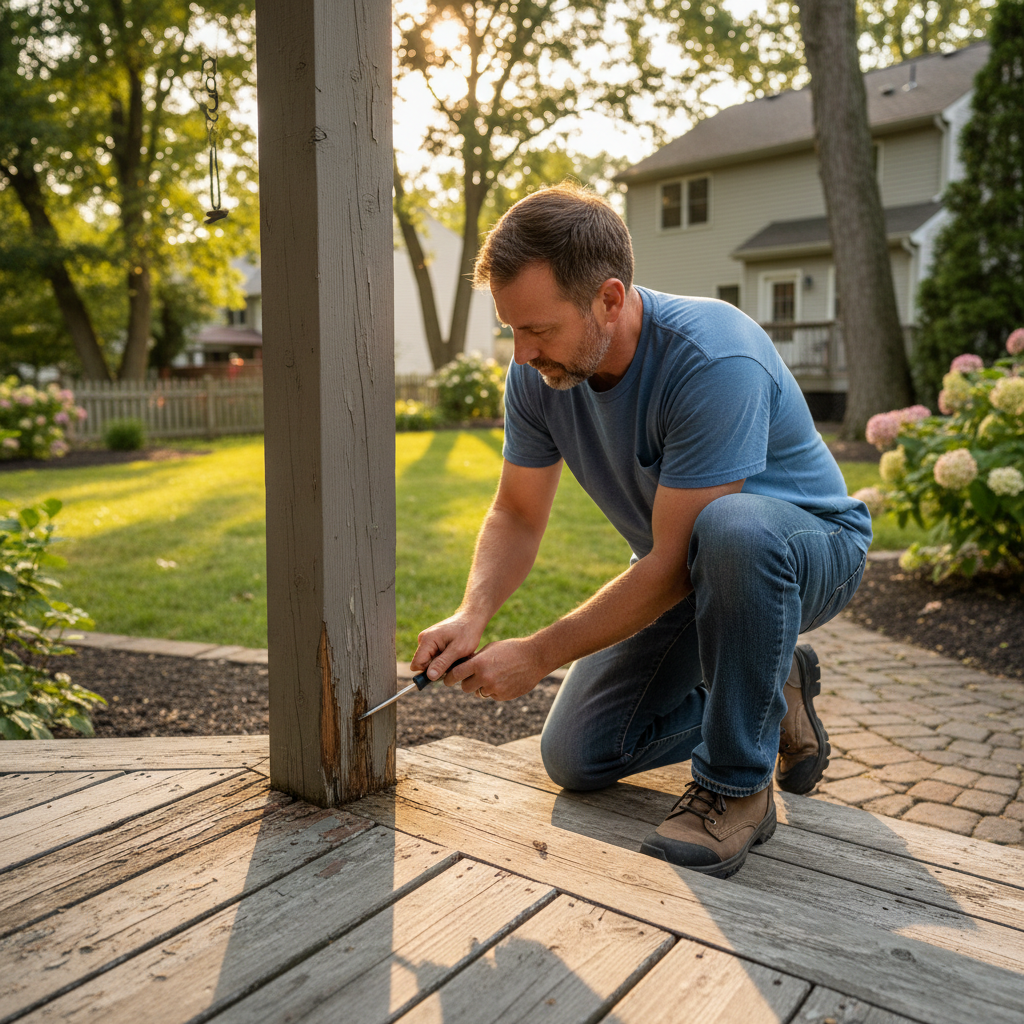
Support Posts: Examine the posts, especially where they meet the ground or concrete footings. This area is constantly exposed to moisture. Probe the bottom 6-8 inches of each post with your screwdriver. If you can easily sink the tip more than a quarter-inch, you're dealing with rot. Also, look to see if the posts are resting on and anchored to concrete footings. Posts buried directly in dirt are guaranteed to rot and are not up to modern building codes.
Joists and Beams: Get underneath your deck with a flashlight. The joists are the smaller boards that run perpendicular to the house, and the beams are the thicker pieces of lumber that the joists rest on. Look for any joists or beams that are sagging, bowing, or have deep cracks. Pay close attention to where wood meets wood or where metal hangers are used—these are all places where moisture can get trapped and cause rot.
What This Means for Hiring a Pro
If your initial inspection reveals any of these structural red flags, your first call should be to a reputable, licensed deck builder—not a handyman. A professional will provide a thorough structural assessment. They can identify code violations you might miss and give you a definitive verdict on the frame's health. If significant rot is present in the posts, ledger, or joists, be prepared for them to recommend a full rebuild. Don't be tempted by a low-ball offer to simply "patch" a failing structure; it's unsafe and a waste of money.
Point 2: Evaluate the Surface Condition (The "Skin")
If the deck's "bones" are solid, the next step is to look at its "skin." This includes the decking boards you walk on, the railings, the stairs, and any trim or fascia boards. Unlike structural failure, widespread surface problems don't automatically mean you need a full rebuild. They do, however, present a different set of choices.
If your frame is in great shape but the surface is a mess, you might be the perfect candidate for "resurfacing." This is a fantastic middle-ground option where a pro removes all the old decking and railings and installs brand new ones on your existing, healthy frame. It gives you the look and feel of a new deck for a fraction of the cost and time of a full rebuild.
Checking Your Deck's Surface
Walk your entire deck and take notes. What percentage of the surface is problematic?
Decking Boards: Are you dealing with just a few splintered or rotten boards, or is the problem widespread? If more than 25-30% of your boards are cupped, cracked, severely splintered, or soft with rot, replacing them one by one becomes a labor-intensive and often unsatisfying job. It can be hard to match the color of new wood to old, resulting in a checkerboard look.
Railings: This is a major safety component. Push firmly on the railings in several spots. Do they feel solid, or are they wobbly and loose? Check the railing posts for rot at their base where they connect to the deck frame. Also, consider modern safety codes. Many older decks have railings that are too low (less than 36 inches) or have balusters spaced too far apart (more than 4 inches), creating a hazard for children. Even if the railing is sound, if it's not up to code, it should be replaced.
Stairs: Stairs take a lot of abuse. Carefully inspect the stair stringers—the saw-toothed structural boards that support the treads. They are often close to the ground and prone to rot. If the stringers are soft or cracked, the entire staircase is unsafe and needs to be rebuilt. Test each step to make sure it feels solid underfoot.
What This Means for Hiring a Pro
When you talk to a contractor, be clear about your findings. Say, "I think the frame is good, but the railings feel loose and about a third of the boards are bad." This helps them understand your needs. Ask for quotes that break down the options:
- A quote to repair/replace only the damaged boards and railings.
- A quote for a full resurface, including new decking and railings.
This comparison will help you see the financial tipping point where a full resurface becomes a better value than piecemeal repairs.
Point 3: Calculate the Cost vs. Long-Term Value (The "Wallet")
Your inspection of the bones and skin gives you the technical data. Now it's time to run the numbers. The decision to repair or rebuild isn't just about the immediate cost; it's about the long-term investment in your home.
A helpful guideline used in many home projects is the "50% Rule." If the cost of repairs is 50% or more of the cost of a full replacement, replacement is almost always the smarter financial move. Pouring a ton of money into an old deck that might only last another 5-7 years before another major repair is needed is often not a good use of your funds.
Breaking Down the Costs
Prices vary by region, materials, and the complexity of the job, but here are some realistic US market ranges to help you budget:
- Minor Repairs: Replacing a few bad boards or securing a loose handrail might cost $300 – $1,000, depending on the extent and labor involved.
- Major Repairs / Resurfacing: Replacing all decking boards and railings on an existing frame (resurfacing) is a popular mid-range option. For a typical 250 sq. ft. deck, you might expect to pay $5,000 – $10,000 ($20-$40 per sq. ft.). This cost is highly dependent on whether you choose pressure-treated wood or a more expensive composite material.
- Full Rebuild: This involves a complete tear-down and building a new deck from the footings up. For that same 250 sq. ft. deck, a full rebuild with pressure-treated wood could range from $10,000 – $18,000 ($40-$70 per sq. ft.). If you opt for higher-end composite decking and railings, that cost could easily be $17,000 – $30,000+ ($70-$120+ per sq. ft.).
Thinking About Long-Term Value
Consider the lifespan of your investment. A repaired 15-year-old wood deck might be safe for another 5 years, but then you'll be facing this decision all over again. A brand new pressure-treated wood deck can last 15-20 years with proper maintenance, while a new composite deck can last 25-50 years with very little upkeep. A new or fully resurfaced deck also adds more to your home's resale value than one that's clearly been patched up over the years.
The Verdict: When to Repair
Repairing or resurfacing is a great choice when your deck meets most of these criteria:
- The entire structural frame—posts, beams, joists, and ledger board—is solid, dry, and free of rot.
- The deck feels stable, with no sagging or bounciness.
- Fewer than 25% of the surface boards and railing components are damaged.
- The existing railings are sturdy and meet current local safety codes for height and spacing.
- The issues are primarily cosmetic (faded stain, small splinters) and can be fixed with cleaning, sanding, and refinishing.
- Your budget is limited, and you need to safely extend the life of your deck for a few more years.
The Verdict: When to Rebuild
A full rebuild is the clear path forward when your deck exhibits any of these major warning signs:
- There is significant rot in the structural posts, beams, joists, or especially the ledger board.
- The deck has noticeably pulled away from the house.
- The entire structure sags, bounces excessively, or feels unstable when you walk on it.
- More than a third of your decking boards are soft, rotted, or otherwise compromised.
- You want to change the deck's size, shape, or design, which requires new footings and framing.
- You want to upgrade from a wood deck to a long-lasting, low-maintenance composite material, and want the frame to have a similar lifespan.
- The estimated cost of repairs is more than 50% of the price of a full replacement.
Navigating the Hiring Process: Permits, Pros, and a Plan
Once you've made your decision, the final step is to bring in the right professional and get the project done correctly. This involves understanding permits, vetting contractors, and knowing what to expect.
Do I Need a Permit?
Permitting rules are set by your local municipality, but a good general rule is:
- Probably Not: For simple, like-for-like repairs such as replacing a few decking boards or a single stair tread.
- Almost Certainly Yes: For a full rebuild, a resurfacing project, replacing railings, or rebuilding stairs. Anything that involves structural elements or safety features typically requires a permit.
A permit isn't just red tape. It triggers inspections by a local building official who verifies that the work is being done to current safety codes—especially for critical elements like footings, framing, and railing attachments. Your contractor should handle the permit application process, but it's ultimately the homeowner's responsibility to ensure a permit is pulled. Be very wary of any contractor who suggests skipping the permit process to save money.
Finding the Right Deck Builder
Don't just go with the first or cheapest quote. This is a major investment in your home's value and safety.
- Get 3-4 Detailed Quotes: A professional quote won't just be a single number. It will break down the costs for demolition, debris removal, materials, labor, and permit fees.
- Check for License and Insurance: Only hire contractors who are licensed to work in your area and carry both liability insurance and workers' compensation. Ask to see their certificates.
- Look for Deck Specialists: While a general contractor can build a deck, a company that specializes in them will be more up-to-date on materials, techniques, and code requirements.
- Review Their Work: Ask for a portfolio of recent projects and the contact information for 2-3 recent clients. A confident pro will be happy to provide them.
By arming yourself with knowledge from your 3-point inspection, you can enter into conversations with contractors as an informed partner, ready to make the best possible choice for your home.
Frequently asked questions
How much does a professional deck inspection cost?+
A standalone professional deck inspection from a qualified deck builder or home inspector typically costs between $200 and $400. However, most reputable deck contractors will include a thorough inspection as part of their process when providing you with a free quote for repairs or a rebuild.
Can I put new composite decking over old wood boards?+
No, you should never install new decking over old boards. Trapping the old wood will prevent it from drying out, accelerating rot and creating a spongy, unsafe surface. Proper resurfacing requires completely removing the old decking to inspect the frame before installing new boards.
How long does a new wood deck last compared to a composite deck?+
A new pressure-treated pine deck can last 15-20 years if it's well-maintained with regular cleaning and staining every 2-3 years. A composite deck, while more expensive upfront, can last 25-50 years or more with just occasional cleaning, making it a lower-maintenance long-term option.
If my deck frame is good, is it worth upgrading to composite decking?+
Yes, this is an excellent and very popular upgrade. If your deck's structural frame has at least 15-20 years of life left, resurfacing with composite is a great investment. You get the benefit of a brand new, low-maintenance surface without the cost of a full structural rebuild.
Do I need a permit just to replace my deck boards?+
This is called 'resurfacing' and in most areas, yes, you will need a permit. Because you are replacing a major component of the deck system, most building departments require a permit to ensure the frame underneath is sound and that the new work meets code, especially if you are also replacing railings.